
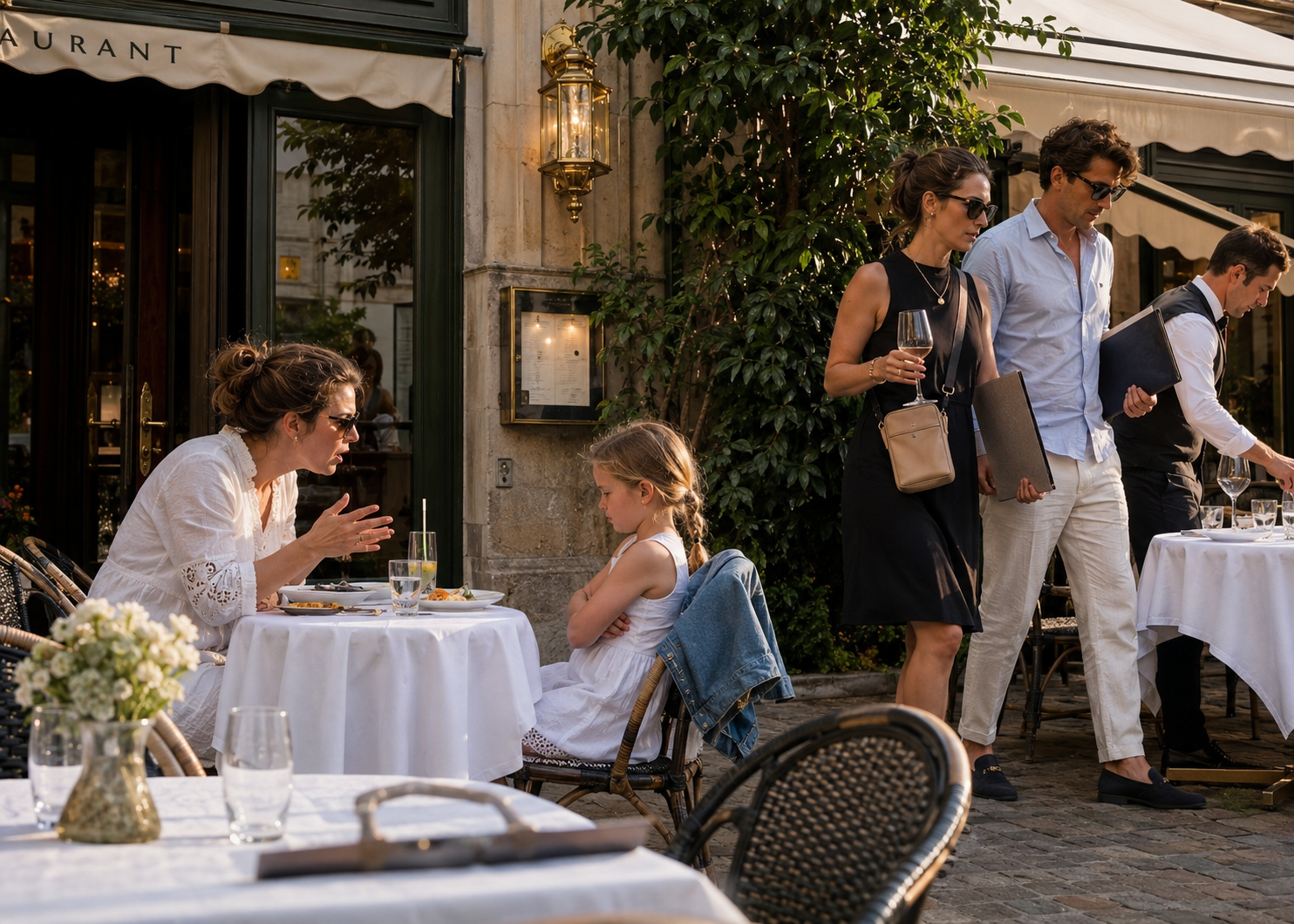
A restaurant in Barcelona on a Wednesday evening at 9:15pm. The dining room is moderately full. The conversation level is the lower-volume Spanish dinner pattern. An American family of four has been seated near the center of the room. The parents are engaged in a continuous management dialogue with their seven-year-old daughter and ten-year-old son.
“Sweetie, you need to use your inside voice. Honey, please put that down. Are you listening to mommy? Look at me when I’m talking to you. We talked about this before we came. Do you remember what we said? I need you to make a good choice right now. Honey, what did mommy just say?”
The dialogue is not loud in absolute terms. It is constant. Across the first 20 minutes of the meal, the mother has spoken approximately 90 percent of the family’s words. The father interjects occasionally with similar management language. The children respond minimally. The dialogue continues regardless of whether the children are doing anything that requires management.
At the table immediately adjacent, a Spanish couple in their fifties who had been enjoying their second course finishes their wine, asks for the bill, and pays. They leave at 9:45pm with their main course only partially eaten. They did not complain. They did not ask to be moved. They did what some Europeans do when American family management dialogues become continuous background noise: they ended their meal and left.
This piece walks through what the American parental dialogue pattern actually is, why it registers differently in European restaurant contexts than in American restaurant contexts, what other American parenting patterns produce similar effects abroad, and what American families visiting Europe can adjust to maintain their parenting approach while reducing the disruption to surrounding diners.
What The American Parental Dialogue Pattern Actually Is
American parenting culture has developed a specific style of parent-child communication that operates differently in restaurants than in other settings.
The dialogue is continuous rather than situational. American parents speaking to children in restaurants often speak continuously, addressing minor behaviors, preempting potential behaviors, reinforcing expectations, narrating the management process. The dialogue functions as constant attention rather than as response to specific issues that arise.
The dialogue is verbose. Children are addressed with full sentences, complex emotional reasoning, explanations of consequences. “Sweetie, when you reach across the table like that, it means I have to ask the waiter to clean up the bread and that’s not fair to him.” The verbose style is intentional in American parenting frameworks. It supports the child’s emotional development and verbal capacity.
The dialogue includes ongoing emotional check-ins. “How are you feeling right now? Are you tired? Do you need anything? Are you having a good time?” The check-ins are constant rather than occasional. They signal parental attention and create opportunities for the child to express needs.

The dialogue is rich in pet names. “Sweetie, honey, baby, buddy, kiddo.” The use of pet names rather than the child’s name in public settings is a specific American pattern. The pet names function as affection markers but produce distinct verbal texture in public.
The dialogue includes ongoing instruction. “Use your napkin. Put your fork in your other hand. Sit up straight. Don’t talk with food in your mouth. Take smaller bites.” The instruction continues across the meal rather than being delivered once at the beginning.
The dialogue is delivered at conversational volume. Not whispered. Not muted. The parents speak to the children at the volume they would use in any conversation. The volume reaches surrounding tables consistently.
The dialogue is delivered in English. Most American families do not modify their speech for the surrounding language environment. The English at conversational volume is distinctly audible to surrounding diners who may or may not speak English.
The combined pattern produces dialogue that is continuous, verbose, audible across the room, and entirely focused on parent-child management for the duration of the meal. Surrounding diners experience this as constant background narration of someone else’s family dynamics for the duration of their own meal.
Why This Pattern Registers Differently In European Restaurant Contexts
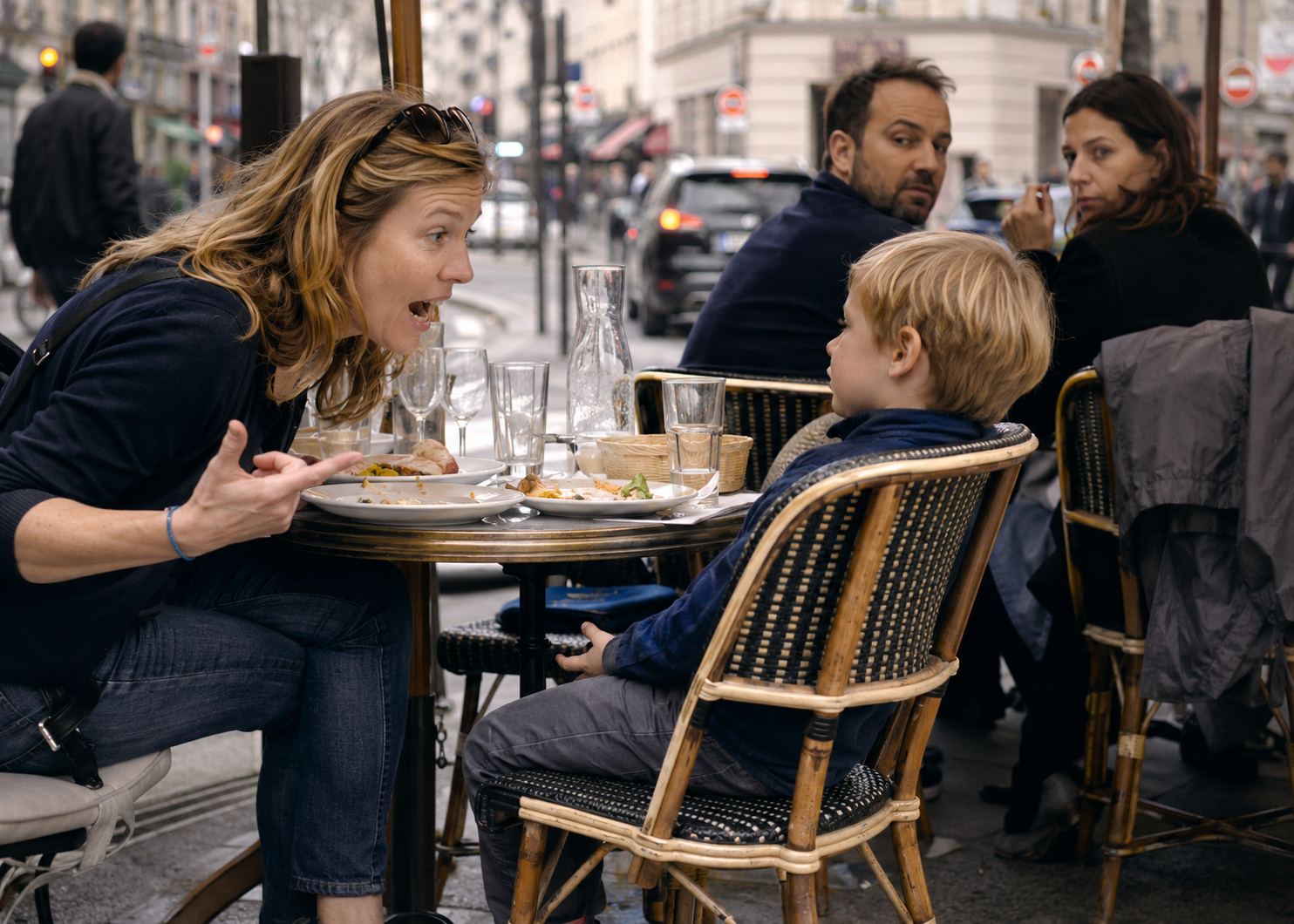
European restaurant culture has specific features that interact with the American parental dialogue pattern in ways that produce predictable effects.
European restaurants operate at lower volume baselines. As discussed in the café volume piece earlier in this batch, European restaurant conversations typically run 10 to 20 decibels quieter than American equivalents. American parental dialogue at American volumes is meaningfully louder than the surrounding conversation in European restaurants.
European children at restaurants are typically quieter. European children eating with their families at restaurants typically sit through meals with less parental management. Spanish, Italian, French, and German children of similar ages produce less restaurant management dialogue from their parents. The European baseline does not include the continuous management narration that American restaurants accommodate.
European parents address children differently when management is needed. When European children do require correction, the correction is typically brief, quiet, and delivered close to the child. “Sit.” “Quietly.” “Look at me.” The correction does not extend into ongoing dialogue. It addresses the specific issue and concludes.
European restaurants are quieter spaces overall. The conversation, the music, the service interactions. The lower overall volume means that any single source of continuous noise becomes more noticeable. The American parental dialogue is one source of continuous noise in a quieter environment.
European diners often choose restaurants specifically for the conversation atmosphere. A meal out is partly the experience of conversation with one’s own dining companions. Continuous background dialogue from another table interferes with this experience in ways that European diners experience as disruption.
European restaurant meals are longer. A 90-minute meal exposed to constant parental dialogue is a 90-minute exposure. The cumulative effect is meaningful even when each individual moment of dialogue is not extreme.
European children are not the focus of the meal in the same way. European family meals at restaurants treat the family as a unit with the children participating rather than as adults focused on managing children. The shift in focus affects the entire dynamic of how the family appears to surrounding diners.
The combined effect is that the American parental dialogue, which works well in American restaurant contexts where it is normal, registers as disruptive background noise in European restaurant contexts where it is anomalous.
What Other American Parenting Patterns Produce Similar Effects
The dialogue pattern is one example of broader American parenting patterns that produce specific effects in European restaurant contexts.
Children at separate tables or in separate spaces. Some European restaurants have spaces where children play. American families often do not use these because they want the children at the family table. The expectation that children remain at the table for the duration of the meal increases the management dialogue.
Constant phone or tablet entertainment. American children at restaurants often have screens to occupy them across the meal. European children typically eat with the adults at the table rather than being separated by screens. The American screen use signals to surrounding diners that the family is operating on a different framework.
Bringing extensive children’s accessories. Backpacks, toys, coloring books, comfort objects spread across the table and floor. The visual accumulation of accessories distinguishes the family from European families that arrive with minimal accessories.
Ordering separately for children from specific children’s menus. As discussed in the Spanish children eating olives piece, European restaurants typically do not have children’s menus. Asking specifically for children’s menus signals American framework operating in European context.
Constant negotiations about food. “Eat three more bites and you can have dessert. Just try the vegetables, then you don’t have to eat any more. If you finish your milk you can have the ice cream.” The food negotiation dialogue is American. European children typically eat what is in front of them or not.
Photographic documentation of the meal. Parents photographing children eating, photographing dishes, photographing the restaurant interior. The continuous documentation is more American than European.
Loud praise and excitement. “Look at you trying the pasta! You’re being so brave! That’s an amazing job, sweetie!” The verbal celebration of routine eating is American. European parents typically do not provide running positive narration of normal child behavior.
Apologetic interactions with servers. “I’m so sorry, can we get more napkins, my son spilled. I’m so sorry to bother you. Thank you so much for being so patient.” The American politeness pattern with restaurant workers, while well-intentioned, can produce its own ambient volume and frequency of server interaction.
Visible stress around child behavior. The American parent who appears visibly stressed by child behavior signals to surrounding diners that the situation is more difficult than it would have been treated by European parents. European parents typically appear calmer about equivalent or worse child behaviors.
The cumulative effect of these patterns is a family presence at the restaurant that operates on consistently different rhythms, volumes, and management approaches than the surrounding European families. The other diners do not necessarily judge the parenting. They recognize that the family is operating on a different framework than the restaurant culture assumes, and they may move or leave to manage their own experience.
Why European Diners Move Or Leave Rather Than Speak Up
European restaurant culture has specific patterns for handling disruption that differ from American direct communication.
Direct complaint is uncommon. European diners rarely speak directly to disruptive tables. They do not approach the family. They do not ask the manager to intervene. The framework does not include this kind of direct intervention.
Subtle environmental management is preferred. Asking to be moved if other seats are available. Finishing the meal more quickly than originally planned. Leaving earlier than originally planned. These responses do not involve confrontation but they do produce the effects that the disrupted diners are seeking.
Restaurant staff may relocate other diners proactively. Experienced European restaurant workers recognize when a table is disturbing surrounding diners and may proactively offer to move the surrounding diners to different tables. The relocation happens without explanation to either table.
Future business decisions are affected. European diners may avoid restaurants where they have had disrupted meals, particularly if the restaurant did not manage the disruption. The economic feedback is delayed and indirect but real.
Direct feedback to the disruptive family is rare. A European diner approaching an American family to comment on the noise would be unusual. The framework does not include this as standard behavior. The American family who would have welcomed direct feedback to know what they were doing may not receive any direct feedback even when their behavior is disrupting surrounding diners.
The result is that American families often do not know they are producing disruption because the European response to disruption does not communicate it. The Spanish couple paying their bill at 9:45pm and leaving with their dinner half-finished has communicated something through their actions, but the American family does not necessarily read this signal as a response to their dialogue.
What American Families Visiting European Restaurants Can Adjust
For American families who want to maintain their parenting approach while reducing the impact on surrounding European diners, several specific adjustments are accessible.
Lower the conversation volume substantially. The dialogue can continue at much lower volume than American baseline. A whispered or close-distance version of the same conversation produces the parenting effects without the room-filling volume. The adjustment is meaningful even when the content of the dialogue is unchanged.
Reduce the frequency of routine check-ins. Once-per-course check-ins instead of continuous check-ins. The same parental attention can be delivered with less frequent verbal contact. The reduction in frequency is more impactful than reduction in content.
Address management issues with brief direct correction. When something needs to be addressed, address it briefly, quietly, and conclude. The 30-second correction is more effective in European contexts than the 5-minute discussion that American frameworks often produce.
Eat at restaurants designed for families. Many European cities have specific restaurants oriented toward family dining. These restaurants accommodate higher noise levels, longer meals with children, and more management activity. They are often less central, less elegant, less expensive than the restaurants Americans typically choose. The trade-off is comfort for the family and reduced impact on surrounding diners.
Time meals when restaurants are emptier. Earlier dinner timing (7:00pm rather than 9:00pm in Spain, 6:00pm rather than 8:00pm in Italy) places the family at the restaurant when fewer diners are present. The reduced presence of surrounding diners reduces the disruption potential. Many European restaurants serve dinner earlier when American families request it.
Engage the children with the meal rather than around it. Talk about the food. Ask the children what they think of the dishes. Have them try things and discuss them. The conversation that is about the meal rather than about behavior management becomes part of the meal experience rather than competing with it.
Limit screen and toy use at the table. Children focused on screens do not engage with the meal. The engagement that the restaurant context can produce is foreclosed by screen use. Some screen use may be necessary for very young children, but the default of full-meal screen access can be reduced.
Sit at tables farther from other diners when possible. Corner tables, tables near walls, tables in spaces somewhat separated from the main dining room. The physical buffer reduces the disruption to surrounding tables.
Acknowledge surrounding diners warmly. A nod, a smile, a brief acknowledgment to nearby tables. The recognition that you are sharing a space with other people produces a small social connection that often softens the response from those diners.
Reduce the use of pet names at conversational volume. “Honey,” “sweetie,” “baby” carrying across the room signals American framework. Using the child’s name in normal volume produces less of the American-family-distinctive verbal texture.
Accept that the meal may be shorter than typical American family meals. A 60-minute meal rather than a 90-minute meal reduces the cumulative exposure for surrounding diners. The shorter meal can still be complete with adjustments to course structure.
What This Pattern Reveals More Broadly

The American family dialogue pattern in European restaurants is one specific example of broader cultural differences in how families operate in public spaces.
American family culture treats children as central to the family activity, with continuous parental attention, verbose communication, and emotional check-ins. The framework reflects American values about child development, parental engagement, and family centrality.
European family culture treats children as participating members of family activities, with less continuous parental attention, more concise communication, and less constant emotional management. The framework reflects European values about child autonomy, social participation, and shared family experience.
Neither framework is universally correct. Both produce children who develop into functional adults. The frameworks have specific features that operate differently in different public contexts. American framework operating in American restaurant contexts produces consistent outcomes. American framework operating in European restaurant contexts produces different outcomes.
For American families visiting European restaurants, the practical implication is not to abandon American parenting values. The implication is to recognize that American framework defaults produce disruption in European contexts that the framework does not produce in American contexts. Small adjustments allow the parenting values to be maintained while reducing the disruption.
The adjustments cost relatively little in parenting terms. The volume reduction does not change the content of parenting. The reduced frequency of check-ins does not eliminate parental attention. The brief direct corrections preserve the parental authority that the continuous dialogue was supporting.
For American families who do not make the adjustments, the consequence is not catastrophic. The restaurants will serve them. The meals will be completed. The trips will continue. The difference is the quality of the meal experience and the relationship with surrounding diners. The unadjusted American family experiences the trip as somewhat colder and less welcoming than they expected. The adjusted American family experiences warm welcoming European restaurants of the kind that European tourism marketing promises.

The Spanish couple at the next table to the American family in Barcelona did not leave because they disliked American children. They left because their dinner had been disrupted by the continuous management dialogue at a volume their dining context did not accommodate. The American family did not register the connection because the framework of why they were left alone, then the table next to them empty, did not include the information about what had happened.
For American families currently planning European travel with children, the dialogue pattern is worth understanding because it shapes the daily restaurant experience across the trip. The same family operating at adjusted volume produces meaningfully different relationships with surrounding diners and with restaurant staff than the family operating on American defaults. The adjustment is small. The cumulative effect is substantial.
European restaurants will not change their cultural patterns to accommodate American family management dialogues. The change available is the American family’s adjustment to the cultural context they have entered. The adjustment preserves the parenting that the family values while allowing the family to participate in the European restaurant culture as it is designed to operate.

About the Author: Ruben, co-founder of Gamintraveler.com since 2014, is a seasoned traveler from Spain who has explored over 100 countries since 2009. Known for his extensive travel adventures across South America, Europe, the US, Australia, New Zealand, Asia, and Africa, Ruben combines his passion for adventurous yet sustainable living with his love for cycling, highlighted by his remarkable 5-month bicycle journey from Spain to Norway. He currently resides in Spain, where he continues sharing his travel experiences with his partner, Rachel, and their son, Han.